How to use AI to understand a letter from your doctor or hospital
A copy-ready prompt that turns the shorthand in a clinic or hospital letter into plain words, lists what happens next and who does it, and adds nothing the doctor didn't write.

Explain my medical letter
I've been sent a letter from [who sent it] after [what happened], and I want to understand it before I [next step]. I've removed my name and other personal details. Please: (1) go through the letter in order and explain every medical word, abbreviation and number in [level], quoting each one first; (2) if an abbreviation could mean more than one thing, say so and don't guess; (3) list everything the letter says should happen next, who does it and when, and say where the letter doesn't say; (4) suggest up to five questions I could ask about it. Explain only what the letter says. Don't diagnose me, don't add treatment advice that isn't in the letter, and don't tell me what this means for my future health. If you're not sure what something means, say so. The letter: [PASTE LETTER]
Tap a blank to fill it in, or copy it as it is.
Letters from clinics are mostly written for other doctors. They're full of shorthand like "FBC", "od" and "4/52", and when a copy lands on your doormat it can be hard to tell what is news, what is routine and what you're supposed to do next. An AI assistant (a chat program such as ChatGPT, Claude, Gemini or Copilot) is good at the translating part: it can take the letter line by line and put each term into plain words. It can't tell you what the letter means for you. That's a conversation for the doctor who wrote it or your GP (your family doctor), and this prompt keeps the assistant to the translating.
If you feel very unwell, or the letter tells you to get urgent help, do what the letter says or call your local emergency number. Don't stop to ask a chatbot.
What you need
- The letter, and a few minutes to copy it out or cover up your details (see "Keep it private" below).
- Any AI chat assistant. The free version is fine for this.
- A pen, to mark the words you didn't understand before you start. You'll check the answer against those.
Step by step
- Read the letter once yourself and underline anything you don't follow. It's often only five or six terms.
- Type the letter out, or paste the text and delete your name, date of birth, address, NHS or insurance number and hospital number. Leave the medical content as it is: changing a word to "make it easier" can change what it means.
- Fill in the prompt and paste the letter at the end. Keep the line "Explain only what the letter says."
- Go through the explanation line by line with the letter beside it. Every quoted term should be one that is actually in your letter, and every number should match.
- Look at the "what happens next" list. Where it says the letter doesn't say who books a test or who will send a result, that's a phone call to make.
- Pick two or three of the suggested questions that matter to you and take them to your GP, the clinic or your pharmacist.
What a good answer looks like
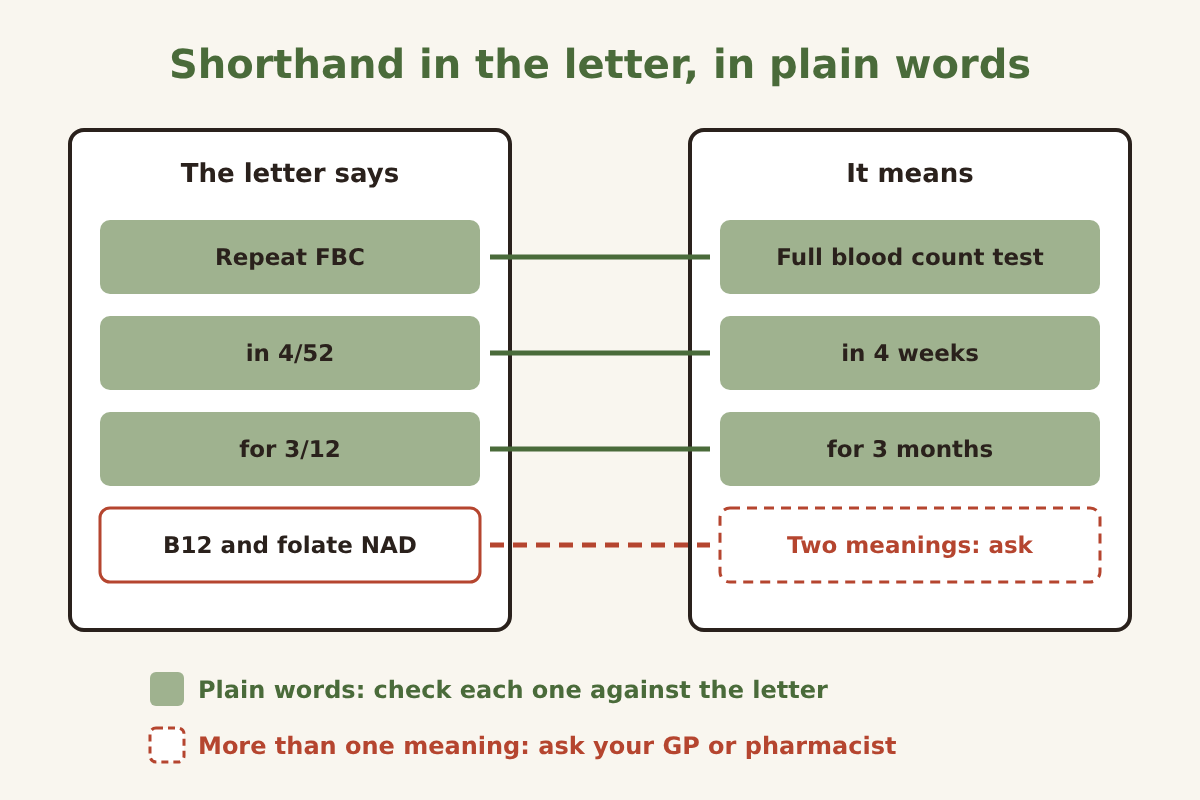
A good answer follows the letter from top to bottom. Each term is quoted and then explained: "Hb" is haemoglobin, the part of the blood that carries oxygen; "4/52" means four weeks and "3/12" three months; a number range in brackets after a result is usually the normal range the lab uses. When it reaches something like "NAD", it tells you the abbreviation has more than one meaning instead of quietly picking one.
The "what happens next" list is the most useful part. It sorts the plan into who does what and when, and it is honest about the gaps: "The letter doesn't say who will tell you the result." The questions are practical ones about your letter, such as who issues a prescription or when a test should be booked, not general health questions.
Expect it to be long. A one-page letter can come back as a few screens of explanation. If that's too much, ask "Now give me just the next-steps list and the questions."
Where it goes wrong
- It adds things that aren't in the letter. Without the "explain only what the letter says" line, assistants tend to fill the gaps: why a test is being done, what a result probably means, tips on taking a medicine. Some of it may be true, but it isn't what your doctor wrote, and it can reassure or worry you for no reason. Anything you can't find in the letter, cross out.
- It guesses at abbreviations. Some shorthand means different things in different specialties. "od" usually means once a day on a prescription, but in eye care it means the right eye. If the assistant isn't sure, believe that. For medicines, the label on the box and the pharmacist who gives it to you will spell out how to take it.
- It turns an "impression" into a fact. Letters often say "impression", "likely" or "?" before a condition, which means the doctor's working view, not a confirmed diagnosis. Check that the explanation keeps those words.
- Copying mistakes. If you typed the letter out, one wrong digit in a result changes everything. Check the numbers in the answer against the paper letter, not against what you typed.
- It can't know your history. The assistant sees one letter. Your GP sees your whole record. If something in the letter worries you, ring the GP practice or the secretary of the clinic that wrote it; their number is usually at the top of the letter.
Keep it private
A medical letter is one of the most personal documents you own, so take out everything that identifies you before you paste it. That means your name, date of birth, address, phone number, NHS, insurance or Medicare number and any hospital or clinic reference number. Remove the names of the doctors too; the assistant doesn't need them. If you'd rather not paste the letter at all, type out only the lines you don't understand. Never upload a photo of the whole letter: it carries the details you meant to leave out. Our guide to what you should never paste into an AI chatbot explains what assistants may keep from a chat and where to find the settings that control it.
If you have an appointment coming up about the same thing, the questions from this prompt are a good start for getting ready for your doctor's appointment with AI.
Tested with
We ran this prompt with OpenAI's GPT-6.2 Sol model (gpt-6.2-sol, through OpenAI's API) in November 2026, using a made-up letter from a hospital blood clinic to a GP about iron-deficiency anaemia, with blood results, an iron prescription marked "od", a coeliac blood test, a repeat blood count "in 4/52" and a list of symptoms to report. It explained every term and number in order, said that "NAD" and "od" each have more than one meaning, and pointed out that "continue for 3/12 after Hb normalises" means three months from when the blood count is back to normal, not from the first tablet. Its next-steps list noted that the letter didn't say who would issue the prescription or pass on the coeliac result, and its questions asked exactly that. The answer ran to about 1,300 words; a second run in the same month came back at about 900, with the same structure. With the short version ("What does this letter mean?"), it gave a friendly summary of a couple of hundred words that stated the condition as settled, added that it could explain the tiredness, gave reasons for each step and a tip about iron tablets that weren't in the letter, and flagged none of the abbreviations.
