How to use AI to write a complaint letter asking for a refund
A copy-ready prompt that turns your notes into a short, calm refund request with the facts in order and a clear deadline. What to check before you send it, especially any legal claims.
Write a refund request
Help me write a short, polite but firm complaint asking for a refund. Here are the facts: I bought [item] from [shop or website] on [date] for [amount]. Order or receipt number: [leave as ORDER NUMBER]. What went wrong: [what happened, with dates]. What I've done so far: [any calls, emails or chats, with dates and what they said]. I want [a refund / a repair / a replacement] by [date]. I live in [country or state]. Keep it under 250 words, stick to the facts, don't threaten anything, and end with what I'll do if I don't hear back. Then list anything I should check or attach before sending it.
Tap a blank to fill it in, or copy it as it is.
A refund request works best when it's short, calm and impossible to misread. That's hard to write when you're annoyed. An AI assistant (a chat program such as ChatGPT, Claude, Gemini or Copilot) is good at exactly this: turning a messy story into a clear letter or email with the facts in order and one clear request. It can't tell you what your legal rights are where you live, so you check that part yourself.
What you need
- An AI chat assistant. The free version is enough for this.
- Your receipt, order confirmation or bank statement line, so you have the date and amount right.
- A short note of what happened and when: when you bought it, when it went wrong, and anyone you've already spoken to.
- A photo of the fault, if there is one to show. You'll attach it to the email yourself; the assistant doesn't need to see it.
Step by step
- Write down the facts before you open the assistant. Dates matter more than feelings here. "Stopped heating on 3 November, three weeks after delivery" beats "it broke almost straight away".
- Fill in the prompt. Leave your order number as the placeholder ORDER NUMBER; you'll paste the real one in at the end.
- Read the draft as if you were the person at the shop. Is it clear what you bought, what went wrong and what you want? If anything is vague, tell the assistant: "Make the request clearer: I want a full refund to my original card."
- Ask it to cut anything you can't back up: "Remove any claim I haven't given you evidence for." Assistants sometimes add details or legal-sounding phrases that weren't in your notes.
- Check your rights at the official source (see below), add anything that applies in your own words, then paste in your real order number and send it from your own email or the shop's complaint form.
- Keep a copy, with the date you sent it.
What a good answer looks like
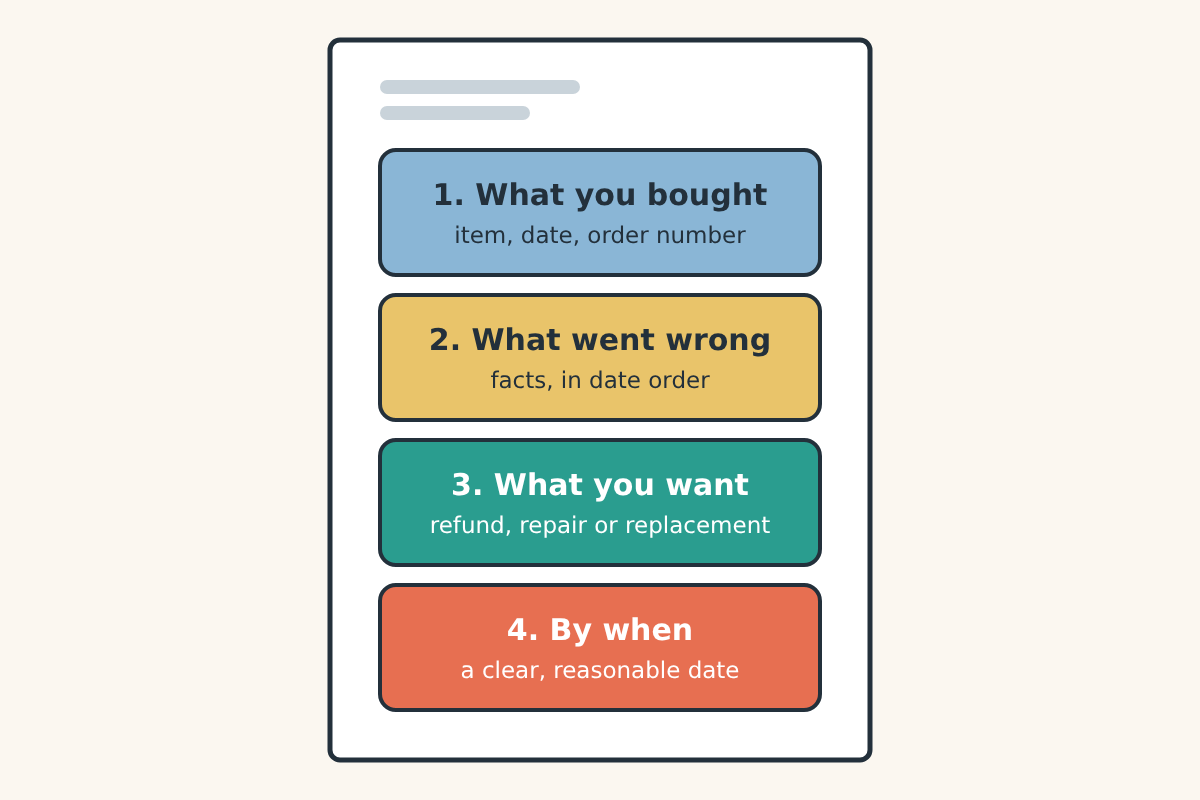
A good draft fits on one screen. The first lines say what you bought and when. The middle gives what went wrong in date order, with no adjectives doing the work of facts. Then one clear request: refund, repair or replacement, and a date to reply by. The last line says what you'll do next if there's no answer, such as escalating to the shop's complaints team or a consumer body, without threats. The checklist under the draft should remind you to attach the receipt and any photos.
Where it goes wrong
- Made-up law. This is the big one. Assistants sometimes name a law, a time limit or a "right" with total confidence, and it can be wrong, out of date, or from the wrong country. Don't send any legal claim you haven't checked on your government's or consumer body's official website. If you're unsure, leave the law out: a clear, factual request works without it.
- Invented details. Read every sentence against your notes. If the draft says you "contacted customer service twice" and you only called once, fix it. A wrong detail gives the shop a reason to doubt the rest.
- Wrong numbers. Check the date, the amount and the deadline. If the assistant worked out a date for you ("14 days from today"), count it yourself.
- Too long or too angry. If the draft runs past one screen or sounds sarcastic, ask: "Shorter and calmer, facts only."
For anything with real money at stake, or if the shop refuses and you're thinking about taking it further, talk to a consumer advice service, a local advice centre or a lawyer before you act on anything the assistant said about your rights.
Keep it private
The assistant doesn't need your full name, address, phone number, email address, card number or bank details. Use placeholders such as [MY NAME] and ORDER NUMBER, and fill them in yourself after you copy the draft out. Never paste a full card number, and never paste account passwords or one-time codes into any AI chat. If you're quoting a chat with the shop, remove the agent's name and your account details first. Our guide to what never to paste into an AI chatbot has the full list.
If the problem is with a rental rather than a purchase, our guide to reading a lease with AI before you sign shows how to find what the contract says first.
Tested with
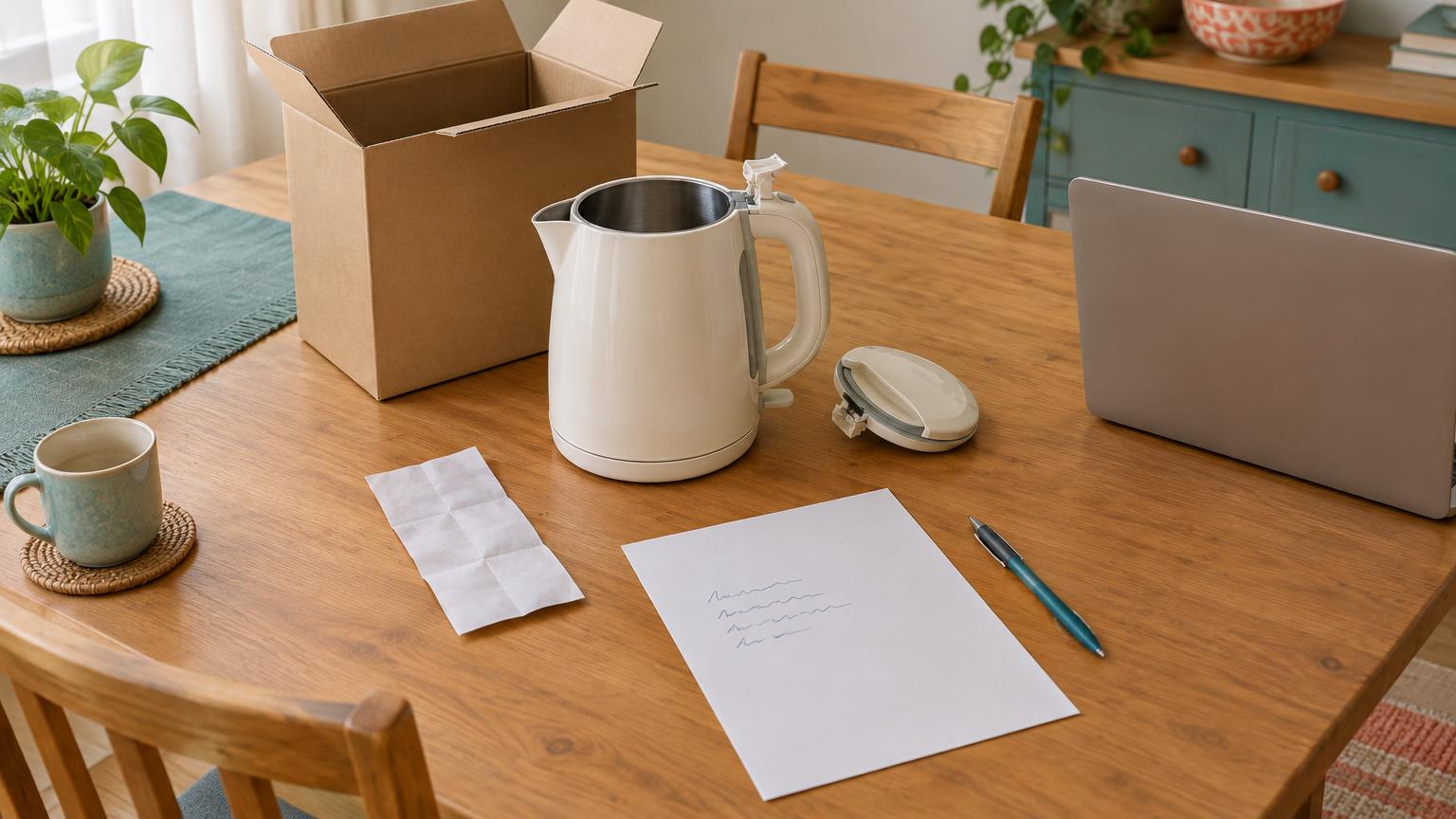
We ran this prompt in Claude in November 2026 for a made-up case: a kettle bought online that stopped heating three weeks after delivery, one unanswered email to the shop, and a request for a full refund within 14 days. The draft came in at about 180 words, put the facts in date order, kept ORDER NUMBER as a placeholder and ended by saying the next step would be the shop's formal complaints process. The checklist under it said to attach the receipt and a photo and to check consumer rules for our country on an official site. When we asked for a "really angry" version, it stayed polite and made the request firmer, and suggested sending the calm one.
