How to use AI to write a cover letter
A copy-ready prompt for a short cover letter built from the job ad and your CV: two real examples, your own reason for wanting the job, and nothing made up.
Write a cover letter for this job
Write a cover letter for a [job title] role at [type of employer]. Here is the job ad and my CV with contact details removed. Keep it under [length] words, in [tone] English. Open with the job I'm applying for and the one reason I'm a strong fit. Then pick the two requirements in the ad that my CV matches best and give one specific example for each, using only facts from my CV. Say why I want this job using my own reason: [why you want it, for example]. End with a short line saying I'd welcome an interview. Don't invent achievements, numbers or anything about the employer, and avoid stock phrases like "I am writing to express my interest". Leave [YOUR NAME] and [EMPLOYER NAME] as placeholders. CV: [PASTE CV] Job ad: [PASTE JOB AD]
Tap a blank to fill it in, or copy it as it is.
A cover letter has one job: show the person reading it, in well under a page, that you have the things their ad asks for most. An AI assistant (a chat program such as ChatGPT, Claude, Gemini or Copilot) is good at picking those out of a job ad and finding the matching evidence in your CV. Left to itself, it also writes like every other cover letter, full of warm claims about you that you never made. This prompt gives it a short brief and keeps it to your facts. The reason you want the job comes from you.
What you need
- An AI chat assistant. The free version is enough.
- The full job ad.
- Your CV as text, with your name and contact details removed. If you haven't matched it to this job yet, tailoring your CV to the job ad first makes this easier, because your strongest matches will already be at the top.
- One honest sentence about why you want this job. The assistant can't know it, and it's the part a reader notices when it's missing.
Step by step
- Write your reason for wanting the job in your own words. One sentence is enough: "I want to move into finance work and learn accounting software."
- Fill in the prompt with the job title, the type of employer, the length and your reason, then paste the job ad and your CV.
- Check the two examples it chose. They should answer the requirements the ad stresses most, and every fact in them should be on your CV.
- Read the letter aloud. Change any sentence you wouldn't say to the person interviewing you.
- If it sounds flat, ask for one change at a time: "Make the opening warmer" or "Use an example from my current job for the second paragraph." Check the facts again after each change.
- Replace [YOUR NAME] and [EMPLOYER NAME], and use the hiring manager's name if the ad gives one. Send it the way the ad asks.
What a good answer looks like
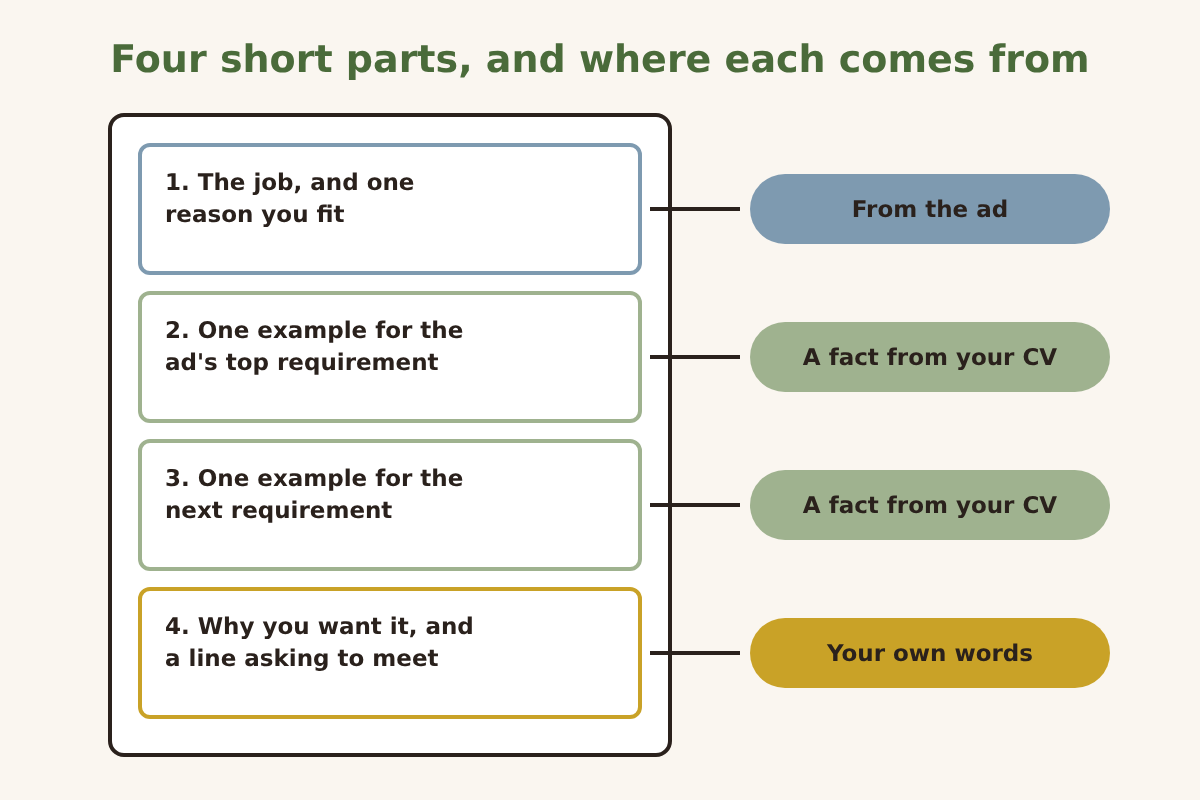
A good letter is short. The first paragraph names the job and gives one reason you fit. The next two each take one requirement from the ad and give one example from your CV, with the result if your CV has one. Then comes your reason for wanting the job, close to your own words, and a line saying you'd welcome an interview. There's nothing in it you would have to explain away.
In our test, the letter came in at about 115 words, well under the 300 allowed. It used the candidate's real result on overdue invoices and their front-desk work, added nothing and kept our placeholders. It was accurate but a little stiff, with one-sentence paragraphs and a plain opening. Asking for one change, such as a warmer first line, fixes that faster than writing a longer brief.
Where it goes wrong
- Invented qualities. With the short prompt, our test letter said the candidate enjoyed working in a small team and that chasing invoices had taught them to keep good relationships with clients. Neither was in the CV. Delete anything you didn't tell it.
- Promises it can't back up. The same letter said the candidate would bring "the same organised approach" to diary management and confidential records, which their CV never mentioned. If the ad asks for something you haven't done, leave it out or say plainly that you'd be learning it.
- Facts about the employer. The assistant may invent what a company does, its values or its recent news. Mention only what you've read in the ad or on the employer's own website.
- Stock phrases. "I am writing to express my interest" and "I would be a great asset" are what readers skim past. The prompt asks it to avoid them; cut any that slip through.
- Local conventions. Sign-offs, length and whether a cover letter is wanted at all vary between countries and industries. When the ad says how to apply, the ad wins. A careers adviser can tell you what's usual where you live.
Keep it private
Take your name, address, phone number, email and date of birth out of the CV before pasting; you'll add them to the letter yourself. You don't have to name your current employer either: "a family-run veterinary practice" works. Leave out referees, and never paste anything confidential from your current job, such as client names or internal figures. More in what you should never paste into an AI chatbot.
When you're invited to interview, the job ad and your letter are the best starting point for practising the interview with AI.
Tested with
We ran this prompt with OpenAI's GPT-6.2 Sol model (gpt-6.2-sol, through OpenAI's API) in November 2026, with a made-up CV for a receptionist and administrator at a veterinary practice and a made-up ad for an office administrator at a 12-person accountancy firm. It chose chasing payments and being the first point of contact for clients as the two strongest matches, used only facts from the CV and kept the placeholders, in about 115 words. With the short version ("Write me a cover letter for this job"), it wrote a letter about twice as long that opened "I'm writing to apply", said the candidate enjoyed small-team work and promised to bring their organised approach to diary management and confidential records, none of which the CV showed.
