How to use AI to tailor your CV to a job ad
A copy-ready prompt that lines up each requirement in a job ad with the line of your CV that proves it, flags the gaps, and suggests changes without inventing anything.

Tailor my CV to this job ad
Here is my CV with my name and contact details removed, and a job ad for a [job title] role. Compare them. First, list the skills and requirements the ad asks for most, in order of how much weight it seems to give them. Then, for each one, show which line of my CV matches it, or say plainly that nothing in my CV does. Suggest changes to my profile and bullet points so the strongest matches come first and use the ad's own words where they truthfully describe what I did. Use only facts that are in my CV: don't add skills, numbers, job titles or dates. If a requirement isn't covered, list it under "Gaps" and ask me whether I have experience of it. Keep my CV to [length]. My CV: [PASTE CV] Job ad: [PASTE JOB AD]
Tap a blank to fill it in, or copy it as it is.
Most job ads spell out what the employer will look for, and most CVs (résumés) don't answer it in the order or the words the ad uses. An AI assistant (a chat program such as ChatGPT, Claude, Gemini or Copilot) does that comparison quickly: it lines up each requirement in the ad with the line of your CV that proves it, and points out where nothing does. It is just as quick to make things up, so this prompt keeps it to the facts you gave it. The assistant does the side-by-side reading; the CV stays yours.
What you need
- An AI chat assistant. The free version is enough.
- Your CV as text, with your name, phone number, email and address taken out. You'll put them back at the end.
- The full job ad, including the "about you" or "person specification" part. That's where most of the requirements are.
- Fifteen minutes, with your CV file open so you can make the changes yourself.
Step by step
- Copy your CV into a plain document and delete the contact details at the top. Keep the job titles, dates and bullet points.
- Fill in the prompt, paste the CV and the job ad where it says, and send it.
- Read the ranked list of requirements first. If it has misread what the ad cares about, say so ("Xero is only desirable") and ask it to rank them again.
- Go through the matches. For each requirement, find the line in your own CV it points to. If it claims a match you can't see, it's wrong.
- Answer the questions under "Gaps". If you have done something the ad asks for and left it off your CV, describe what you did in plain words and ask for one bullet point that uses only that.
- Make the changes in your own CV file, one at a time, and read each new line aloud. If you couldn't talk about it for a minute in an interview, change it back.
- Put your contact details back and save a copy named for this job, so you know which version you sent.
What a good answer looks like
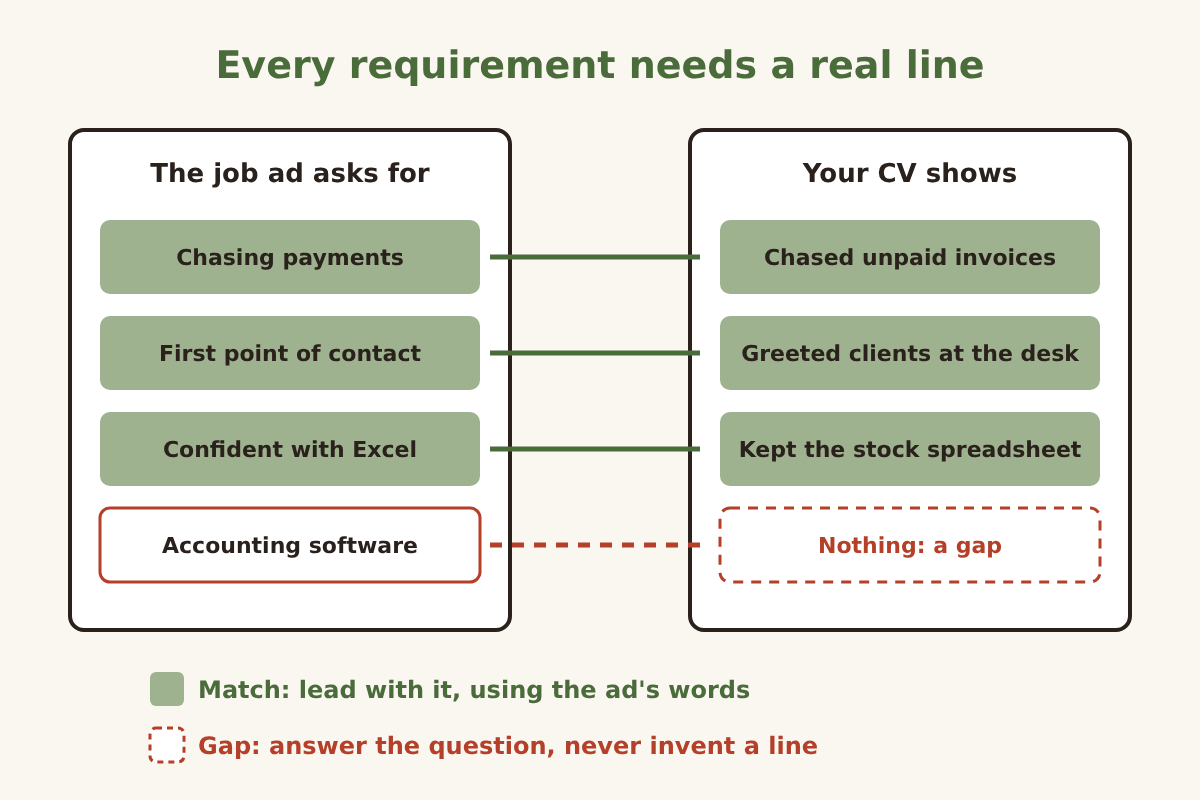
A good answer opens with a short verdict: your two or three strongest matches and what to lead with. Then the ad's requirements in order of weight, each with the exact line of your CV that matches it, or a plain "no line in your CV shows this". The suggested CV moves the best evidence to the top and borrows the ad's wording only where it's true, such as "first point of contact for clients" in place of "answer phones and greet clients", if that is what you did. The gaps come back as questions, not as new bullet points.
In our test, the answer told the candidate to lead with their clearest result, cutting overdue invoices, because the ad asked for experience of chasing payments. It kept every number exactly as written and asked whether they had used accounting software rather than adding it.
Where it goes wrong
- Made-up skills and polish. Without the "use only facts" line, the assistant adds things that sound right. In our test, the short prompt put a job title the candidate had never held under their name and said they had trained new staff "in front-desk procedures", which the CV never mentioned. Check every line of the new version against the old one: anything on your CV can come up in an interview.
- Similar words, different experience. Balancing a till is not reconciling client payments in accounting software. If the assistant treats them as the same thing, you don't have to. Ask it: "Which of these matches only share similar words?"
- Wrong weighting. It guesses what matters most from the ad's order and wording. If you know the job, or someone at the employer has told you what they want, trust that over the ranking.
- One country's habits. Expectations about length, photos and personal details differ between countries and industries, and the assistant may give you one country's habits as if they were rules. A careers adviser, your local public employment service or the employer's own application guidance is the better guide.
- Everything starts to sound like the ad. A CV that repeats the ad line by line reads as copied. Use the ad's words for the two or three things it cares about most, and your own words for the rest.
Keep it private
The assistant doesn't need to know who you are to compare a CV with a job ad. Before pasting, take out your name, address, phone number, email, date of birth and any ID or National Insurance or Social Security number. You can describe employers by type ("a family-run veterinary practice") if you'd rather not name them. Leave out your referees' names and contact details. Never paste anything confidential from your current job, like client names or figures your employer hasn't published. Our guide to what never to paste into an AI chatbot has the full list.
Once the CV is ready, the same job ad keeps working for you. Our guide to writing a cover letter with AI uses it to pick the two examples worth telling, and practising for the interview with AI uses it to ask the questions you're likely to get.
Tested with
We ran this prompt with OpenAI's GPT-6.2 Sol model (gpt-6.2-sol, through OpenAI's API) in November 2026, using a made-up CV for a receptionist and administrator at a veterinary practice and a made-up ad for an office administrator at a 12-person accountancy firm. It ranked eight requirements, matched each one to a CV line or said that nothing matched, and listed eight gap questions, among them Xero, diary management and GDPR. The rewritten CV kept every fact and number and moved the overdue-invoice result up to the second bullet. With the short version ("Make my CV better for this job"), it went straight to a polished rewrite with no comparison, added a job title the candidate had never held, and mentioned the gaps only in a closing note.
