How to use AI to turn leftovers into dinner
One prompt turns what is already in your fridge into three quick dinners, with steps and almost nothing to buy, and leaves the food safety call to you.
Turn leftovers into tonight's dinner
I have these leftovers in the fridge: [leftovers]. I also have [basics]. I have about [minutes] to cook, for [people] people, and we don't eat [foods we avoid]. Suggest three dinners that use the leftovers as the main part. For each, give the steps in order, anything else I'd need to buy (keep it to nothing or one or two things), and which leftovers it uses up. Don't tell me how many days my leftovers are safe to eat: I'll check that myself.
Tap a blank to fill it in, or copy it as it is.
Tell an AI assistant (a chat program such as ChatGPT, Claude, Gemini or Copilot) exactly what's sitting in your fridge and how long you've got, and it will give you three dinners built around it, with steps and a very short shopping list. It's the quickest fix for the "what do I do with half a chicken" moment, and the prompt above (a prompt is what you type to the assistant) keeps it to food you already have.
The one thing to keep out of the assistant's hands is the question of whether the leftovers are still fine to eat. That's for you and your country's food safety advice, which is why the prompt tells it not to answer.
What you need
- Any AI chat assistant. The free version is fine.
- Two minutes with the fridge door open, listing what's there and roughly how much: "half a chicken" plans better than "chicken".
- The basics you always have: eggs, an onion, a tin of tomatoes, frozen veg, bread, cheese.
Step by step
- Check the leftovers first. Throw out anything you're unsure about before you plan around it, using your food safety agency's advice rather than a chatbot's.
- Fill in the brackets. Amounts help: "a bowl of rice" tells the assistant whether there's enough for four.
- Send it and read all three ideas before you pick. One will usually suit tonight better than the others, for example a soup if the rice is short.
- Ask for changes in plain words: "Make the second one without the oven" or "My kids won't eat the onion, take it out". You don't need to start again.
- Cook from the steps, and taste as you go. The steps are a guide, not a tested recipe.
- If there's still food left over, ask: "What can I freeze from this for next week?"
What a good answer looks like
Three dinners that really use your leftovers as the main part, not as a garnish. Each one lists what to buy (ideally nothing), says which leftovers it uses up, and gives short numbered steps you can follow at the stove. Good answers also point out which idea copes best with smaller amounts, so you're not caught short halfway through.
Watch for a plan that quietly needs a trip to the shop for every dish. If two of the three need shopping, say so: "I don't want to buy anything, try again with only what I listed."
Where it goes wrong
- Food safety. An assistant can't see or smell your leftovers, and how long cooked food keeps, how to cool it and how to reheat it are set by food safety agencies, whose advice differs between countries. Don't take a number of days or a temperature from the chat. In the UK, the government's guidance on how to chill, freeze and defrost food safely is the place to check; elsewhere, use your national food safety agency's own website.
- Quantities it assumed. If you write "eggs" without saying how many, the assistant picks a number. Check each dish against what's actually in the box before you start.
- Kit you don't have. Ideas can call for a grill, an oven-safe pan or a blender. Say what you have, or ask it to stick to one pan.
- Allergies. Never treat a suggestion as safe for someone with an allergy. Shop-bought stock, sauces and spice mixes can contain allergens, so check the labels yourself.
- Cooking times. "20 minutes" may not include chopping. If time is tight, ask for the total time including prep.
Using up leftovers on purpose is one of the habits in five easy ways to waste less food at home, alongside planning before you shop. If you'd rather plan the whole week so there's less left over in the first place, try planning a week of family dinners and the shopping list with AI.
Keep it private
There's nothing personal in a fridge list, so keep it that way. You don't need names, your address or your shop's loyalty number. If someone eats a certain way for a medical reason, give the food rule ("no gluten", "low salt"), not the diagnosis. For the bigger picture, see what you should never paste into an AI chatbot.
Tested with
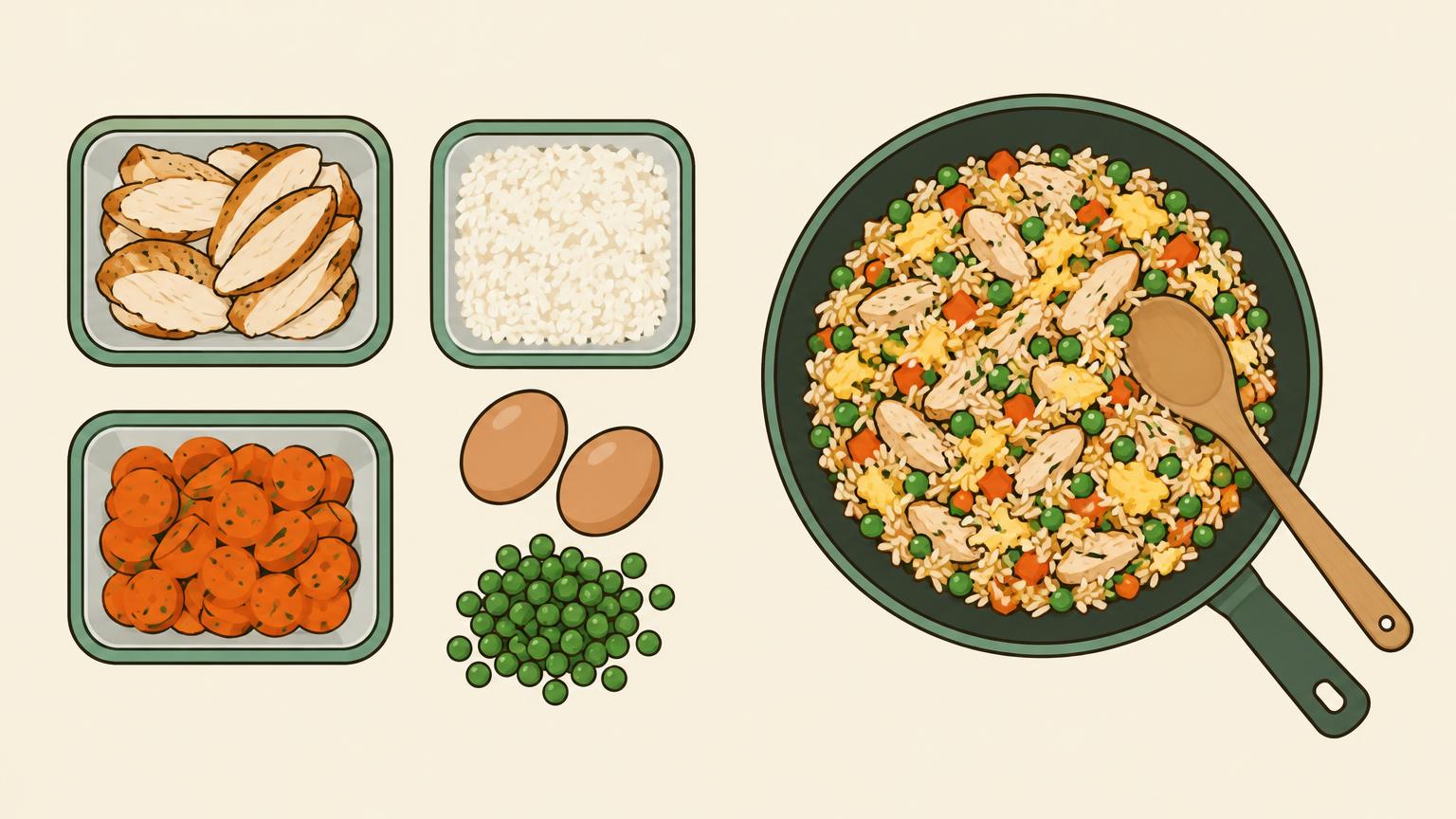
We ran this prompt with OpenAI's GPT-6.2 Sol model (gpt-6.2-sol, through OpenAI's API) in November 2026 with half a roast chicken, a bowl of cooked rice and three cooked carrots, plus eggs, an onion and frozen peas, 20 minutes, four people and no spicy food. It suggested chicken, egg and pea fried rice with nothing to buy, a chicken and rice soup needing only stock, and a chicken and vegetable frittata with warm rice. Each listed what it used up, and it said the soup was the easiest to stretch if the rice ran short. It assumed three eggs for the fried rice and six for the frittata, though we hadn't said how many we had, and the frittata needed a grill and an oven-safe pan.
We also ran it without the last sentence about food safety. The dinners were much the same, but it added its own line on leftover safety with a reheating temperature in Fahrenheit and Celsius. That's exactly the kind of figure to check against your own country's guidance rather than take from the chat, so we kept the sentence in the prompt.
