How to use AI to help your child with homework without doing it for them
A prompt that turns an AI assistant into a patient tutor: it asks your child questions and gives a practice problem instead of handing over the answer. How to use it and what to check.

Help my child understand their homework
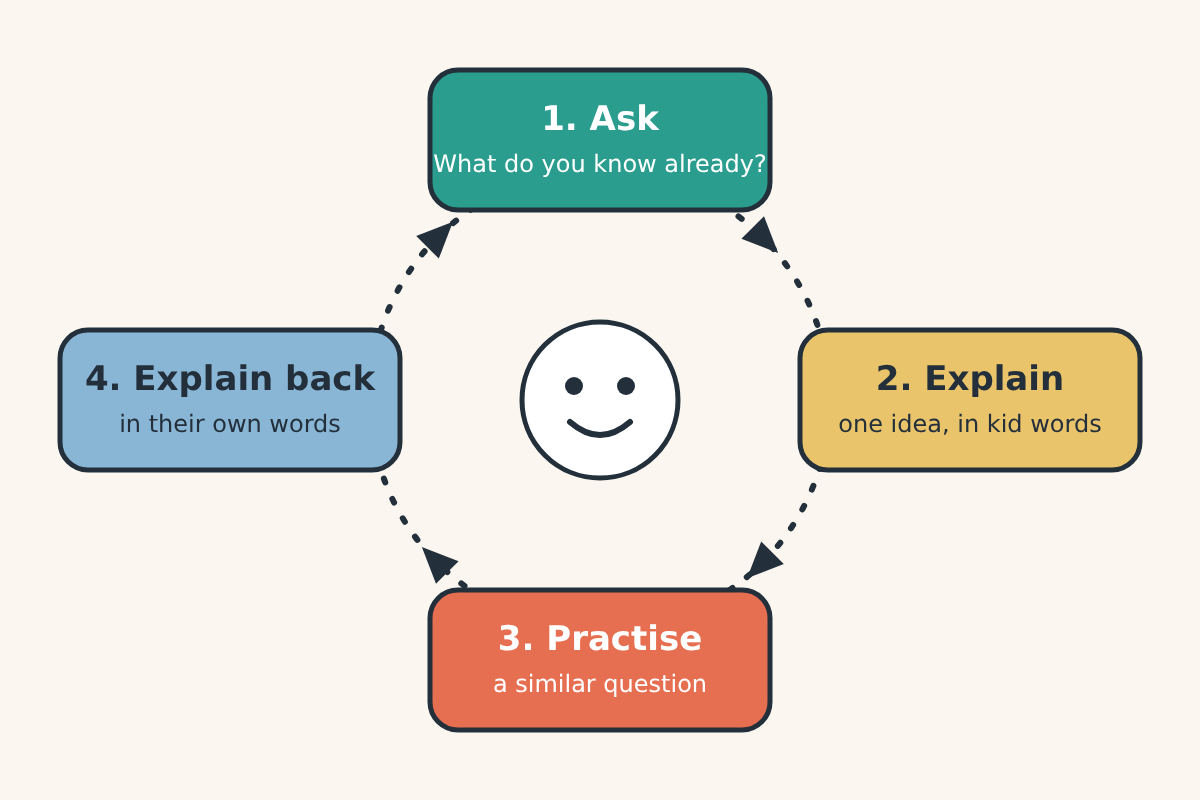
My child is [age] and in [school year or grade]. They are stuck on this homework question: [type out the question]. Their teacher uses [the method they were taught, if you know it]. Act as a patient tutor talking to my child. Do not give the answer. Ask one question at a time to find out what they already know, then explain the idea in words a [age]-year-old understands. When they are ready, give one practice question like this one but with different numbers or words. At the end, ask them to explain how they did it in their own words. Wait for their reply after every question.
Tap a blank to fill it in, or copy it as it is.
An AI assistant can be a patient tutor at 8pm when you've forgotten how long division works. The catch: ask it for help and it will usually just solve the problem. That gets the worksheet done and teaches your child nothing. The prompt above turns the assistant (the chat program you type to, such as ChatGPT, Claude, Gemini or Copilot) into a tutor that asks questions instead of handing over answers.
What you need
- An AI chat assistant. This job doesn't need any paid features.
- The homework question, typed out. You can photograph a worksheet instead, but crop off your child's name and school first.
- Ten to twenty minutes sitting next to your child. This works best as something you do together, not something you hand over.
Most assistants set a minimum age in their terms, and some ask for a parent's permission for teenagers. Check the terms of the one you use before your child uses it alone.
Step by step
- Fill in the brackets. The age matters most: an explanation for a 7-year-old and one for a 13-year-old are very different. If you know how the school teaches the topic ("they use the grid method for multiplication"), say so, or the assistant may teach a method that confuses your child in class.
- Send it, then let your child do the typing or answer out loud while you type. The assistant should reply with a question, not a solution.
- If it gives the answer anyway, reply: "Please don't give answers. Go back and ask them one question at a time." It will usually correct course.
- Do the practice question. This is the part that tells you whether the idea has sunk in. If your child gets it wrong, ask the assistant: "They got [their answer]. Where did they go wrong? Give a hint, not the answer."
- Finish with the explain-back. If your child can tell you how they did it, they've learned it. Now they can do the real homework question on their own.
What a good answer looks like
The first reply is short and ends with a question for your child, such as "What does 3/4 mean to you?" Explanations use everyday things (pizza slices, coins, steps) and one idea at a time. The practice question is the same kind of problem, not a harder one. Nowhere in the chat does the assistant write out the answer to the real homework question.
If you get a long wall of text with every step worked out, the assistant has slipped into "solve it" mode. Remind it of the rules and keep going.
Where it goes wrong
- Wrong maths, said confidently. AI assistants still make arithmetic and logic mistakes, especially with several steps. Check the practice answer yourself, or against the textbook's answer section if it has one.
- A different method from school. There is often more than one way to do a sum or structure an essay. If your child says "that's not how we do it", believe them and tell the assistant which method to use.
- Too much help. Even with the prompt, some replies give away nearly everything. If your child is copying rather than thinking, slow down and ask for "just a hint".
- Made-up facts in reading, history and science. The assistant can invent dates, quotes and details. For anything factual, check the textbook or the sources the teacher gave.
- School rules. Some teachers welcome AI help; some don't allow it for homework at all. Check the class or school policy, and if it isn't clear, ask the teacher. Using the assistant to understand an idea is very different from handing in its work.
Keep it private
This job needs no personal details at all. Leave out your child's full name, their school, their teacher's name and any login for school apps. If you photograph a worksheet, crop or cover the name box first. Don't paste in report cards or notes about special educational needs; if it matters, describe what helps ("explain with pictures, short sentences") instead. Our guide to what never to paste into an AI chatbot covers the rest.
If homework time clashes with dinner most nights, a weekly family chore chart or a planned week of dinners can free up the half hour.
Tested with
We ran this prompt in Claude in November 2026 for a 10-year-old with this question: "A recipe uses 3/4 cup of flour for one batch of muffins. How much flour do you need for 2 batches?" The first reply asked whether two batches would need more or less flour than one, then waited. It explained 3/4 as three quarter-cups, so two batches are six quarter-cups, and gave a practice question with 2/3 of a cup and three batches. When we ran the same question without the line "Do not give the answer", the reply worked through the whole sum and gave 1 1/2 cups in the first message. That one line is what makes the prompt work.
