How to use AI to plan a kid's birthday party
One prompt gives you a party timeline, age-right games, a food and shopping list and a two-week countdown. How to adjust it, and what an AI plan gets wrong about allergies and venues.
Plan a kid's birthday party
I'm planning a birthday party for my child, who is turning [age]. About [number] children are coming. It's at [home, a garden, a park or a hall] on [day], from [start time] to [end time]. My budget is about [amount], and they love [interests]. Please give me: a timeline for the party in 15-minute blocks, three games or activities that suit this age and this space, simple food that needs [no oven / a kitchen], a shopping list with quantities, and a countdown of what to do two weeks before, one week before and the day before.
Tap a blank to fill it in, or copy it as it is.
A child's party has a lot of small moving parts, and most of the stress is in remembering them. An AI assistant (a chat program such as ChatGPT, Claude, Gemini or Copilot) can turn "dinosaur party, ten kids, Saturday" into a timeline, a game plan, a shopping list and a to-do countdown in one go. It won't know your child or your venue, so you'll still make the calls, but you start from a full plan instead of a blank page.
What you need
- An AI chat assistant. The free version is enough.
- The basics: your child's age, roughly how many guests, where and when, a budget and what your child is into right now.
- Any food allergies or dietary needs among the guests, if parents have told you. You'll describe them without names.
Step by step
- Fill in the brackets and send. The age and the space shape everything: games for a 4-year-old in a flat are nothing like games for a 9-year-old in a park.
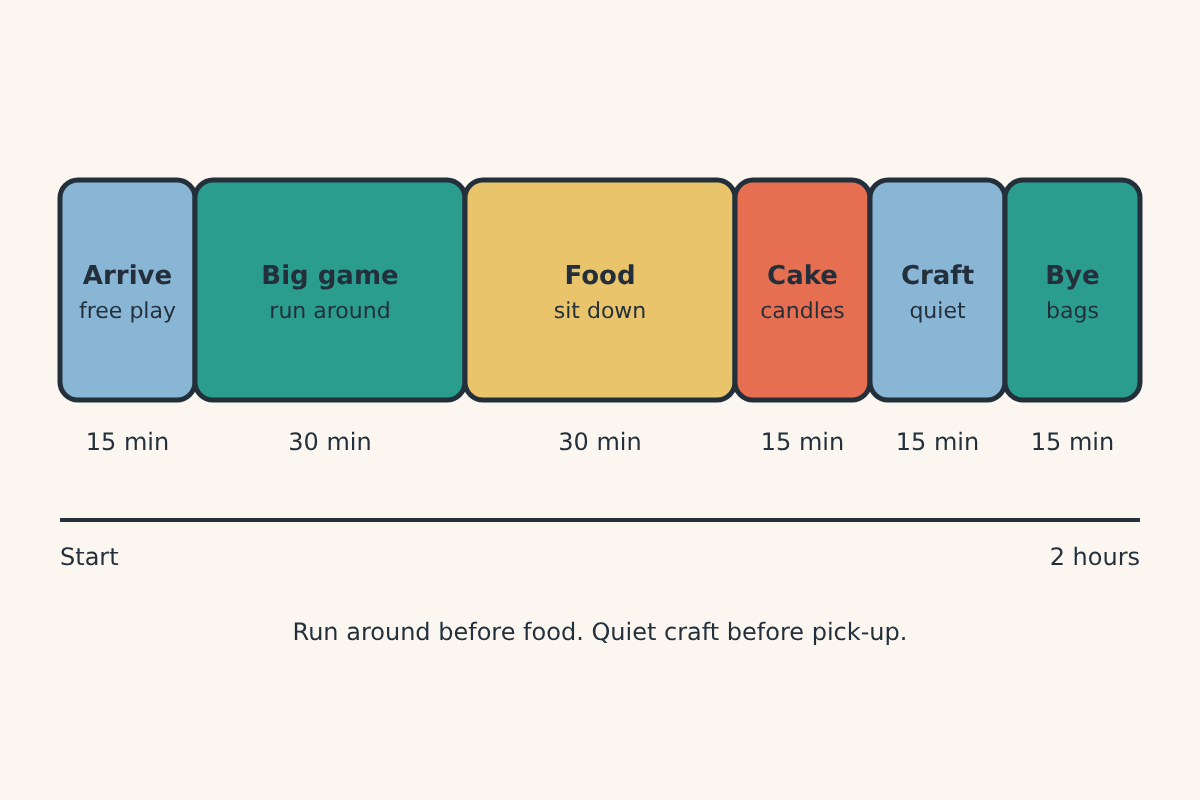
- Check the timeline first. Two hours is plenty for most young children. If the plan has more than one or two big games, ask: "Make this calmer, with a quiet activity before pick-up."
- Swap anything that won't work: "We can't do water games, it's November" or "Replace the craft with something that doesn't need glue."
- Ask for a food list that fits your guests: "Two guests can't eat nuts and one is vegetarian. Adjust the food and the shopping list."
- Ask for the invitation text: "Write a short invitation with [date], [time], [address] and a request to tell me about allergies." Keep the brackets and fill them in yourself after you copy it out.
What a good answer looks like
The timeline covers the whole party with nothing longer than half an hour, and it starts with something children can join as they arrive. Games come with one or two lines of rules and say what you need for them (a ball, paper, music). The food is simple and quick to set out, and the shopping list gives amounts for your number of guests. The countdown spreads the jobs out so the day before is mostly shopping and setting up.
Where it goes wrong
- Allergies. An AI-written menu is not allergy-safe. It can miss nuts, egg or milk hidden in cakes, sauces and snacks. Ask parents directly, read every label, and keep food for a child with a serious allergy simple and clearly separate.
- Choking risks for little ones. Assistants sometimes suggest whole grapes, popcorn, nuts or hard sweets for young children. Leave those out for toddlers and preschoolers, or prepare them the way official child-safety advice recommends (the NHS, for example, says to cut grapes into quarters for young children). Pick up broken balloon pieces straight away.
- Too much in too little time. Plans can pack five games into an hour. Young children need more time than you think to move from one thing to the next.
- Venue rules. The assistant doesn't know whether your park needs a booking or whether your hall allows candles or decorations on the walls. Ask the venue.
- Costs. It can't see your local prices, so any cost it gives is a guess. Use your budget as a steer for the kind of party it plans, and check the shopping list against real prices before you promise yourself a total.
Keep it private
You don't need any guest's name for this job. "Ten children, two with nut allergies" is all the assistant needs. Don't paste in other parents' phone numbers or email addresses, your home address or your child's full name and birth date. If you want the assistant to write the invitation, keep the address and date as [brackets] and fill them in yourself after you copy the text out. More on this in what not to paste into an AI chatbot.
The same kind of prompt can plan the family's dinners for the week after, and a fair chore chart can share out the tidy-up.
Tested with
We ran this prompt in Claude in November 2026 for a 7th birthday: ten children, a back garden on a Saturday from 2pm to 4pm, a small budget and a child who loves dinosaurs. The plan opened with free play while guests arrived, then a dinosaur egg hunt in the garden, a stomp-and-freeze dancing game, food, cake, and a quiet table for decorating paper dinosaur masks before pick-up. The shopping list gave quantities for ten children plus a few spare. When we added "two guests can't eat nuts", it rewrote the menu and the list and reminded us to check labels on the cake and snacks. When we asked it to keep within the budget, it gave rough costs, which we treated as guesses because it couldn't see real prices.
